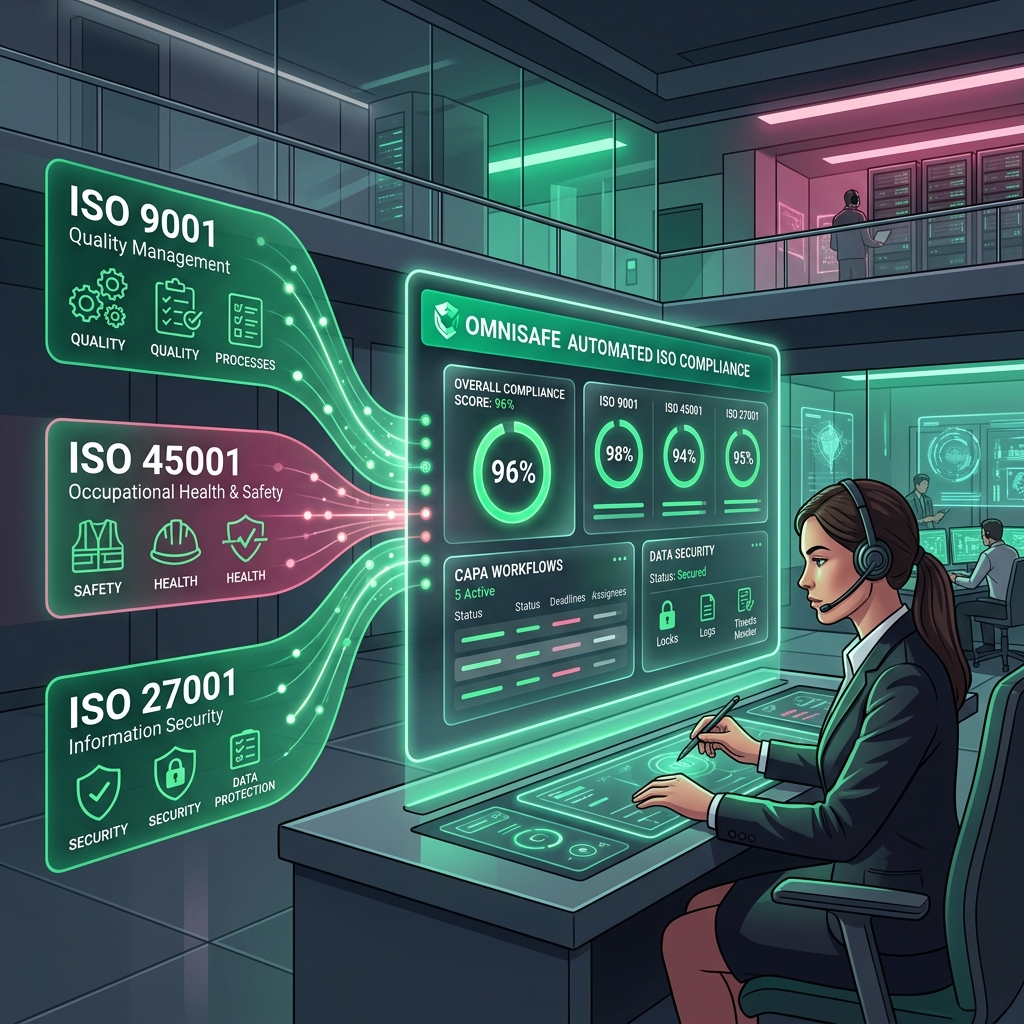
In the modern corporate ecosystem, achieving and maintaining International Organization for Standardization (ISO) certifications has become a core commercial requirement. Whether bidding for multi-million dollar enterprise tenders, expanding into international markets, or establishing corporate credibility, businesses must demonstrate rigorous alignment with international benchmarks.
However, for enterprise compliance officers, operations directors, and SHEQ managers, the path to certification is notoriously complex. Scaling multiple certifications simultaneously—specifically ISO 9001 (Quality Management System), ISO 45001 (Occupational Health & Safety Management System), and ISO 27001 (Information Security Management System)—has historically required thousands of printed pages, overflowing lever-arch binders, and hundreds of hours of manual administrative labor.
The administrative friction of manual compliance tracking is not only expensive; it is a major operational risk. When compliance is managed via disconnected spreadsheets and paper files, gaps go unnoticed, audits become stressful emergencies, and certifications are put at risk. The modern enterprise must find a way to streamline operations, map internal activities to standards in real-time, and continuously comply to ISO frameworks without the administrative headache.

Understanding the Triple Crown of Enterprise ISO Frameworks
To successfully automate compliance, organizations must understand the unique requirements of the three core ISO standards and how they intersect in a unified digital ecosystem:
- ISO 9001 quality management: Focuses on document control, process consistency, customer satisfaction, and continuous improvement. It requires organizations to maintain strict records of training, process workflows, and operational quality checks.
- ISO 45001 health and safety: Dictates the management of occupational health and safety risks. It mandates continuous hazard identification, incident logging, daily tool checks, and worker safety training to reduce workplace incidents.
- ISO 27001 data security: Requires a structured Information Security Management System (ISMS). It mandates strict data access controls, employee security awareness training, and comprehensive incident response plans to safeguard sensitive company and client information.
Managing these standards independently in separate, siloed databases results in massive duplicated effort and resource drain. For example, a single employee safety training record is required under ISO 45001 as proof of safety competency, under ISO 9001 as proof of operational process training, and potentially under ISO 27001 as proof of security awareness. By deploying automated compliance frameworks, organizations can map a single operational data point or training record to multiple compliance clauses simultaneously.
This multi-standard mapping turns a linear compliance model into a relational database network. Instead of creating and managing three separate directories, compliance managers can upload a single document or verify an action once, and watch the platform automatically associate it across quality, safety, and security standards. This unified mapping reduces database footprint, eliminates operational silos, and ensures that when an auditor inspects any framework, they are presented with a single, consistent source of compliance truth.
Unified Compliance: Leveraging the Risk Management Module and Live Registers
The foundation of automated compliance lies in how data is structured and processed. Rather than treating compliance as a static record, a modern QHSE platform maps operational activities to ISO clauses in real-time. This is achieved by linking safety checks, equipment inspections, and document approvals directly to the specific standards they support.
A key component of this architecture is the centralized risk management module. Instead of static, yearly risk spreadsheets that gather dust, the module maintains a dynamic, live risk register. When a field worker logs a hazard or an equipment failure via mobile inspections, the live register updates automatically. The system recalculates risk levels, alerts management, and suggests mitigations, satisfying the continuous risk identification requirements of both ISO 9001 and ISO 45001.
Real-Time Risk Recalculation
Operational hazards logged in the field are automatically calculated and pushed to the live risk register, showing a real-time compliance posture.
Cross-Standard Mapping
A single corrective action is automatically mapped to quality, safety, and security clauses, eliminating duplicate data entry and administrative friction.
Closing the Loop: Connecting Site Inspections to CAPA Action Items
A critical requirement across all ISO frameworks is the identification, resolution, and prevention of non-conformances. Under ISO 9001 and ISO 45001, organizations must demonstrate that they actively run processes for corrective and preventive actions (CAPA) to address operational gaps.
Automation transforms this workflow. When an inspector identifies a hazard or process deviation using specialized site inspections software, the platform does not simply log the issue. It immediately triggers a CAPA workflow. The system automatically generates a list of tracked CAPA action items, assigns them to the responsible personnel, sets resolution deadlines, and tracks progress.
This continuous, closed-loop workflow is enforced by automated escalation rules. If a critical CAPA action item remains unaddressed by its assigned owner as the deadline approaches, the platform automatically escalates the task to higher management, logs the delay in the system, and recalculates the team’s overall compliance score. This ensures that operational hazards are actively managed, preventing minor process deviations from growing into costly incidents or compliance breaches.
Once remediation is complete, the closing verification is logged in the system, providing auditors with clear, digital evidence of the organization’s commitment to continuous improvement. This end-to-end logging demonstrates to ISO 9001 and ISO 45001 auditors that the company possesses a mature, self-correcting compliance ecosystem that actively identifies, resolves, and prevents operational errors.
Continuous Readiness with OmniAudit AI™
Traditional ISO audits are stressful, high-pressure events. Compliance teams spend weeks gathering physical records, chasing signatures, and compiling files.
Omnisafe eliminates this prep phase with omniaudit ai. By running continuous, automated compliance auditing on the background, the AI-driven system scans your company's records daily, checking for compliance gaps, missing signatures, or expired certificates.

If a subcontractor’s insurance certificate expires or a worker is assigned to a site without having completed their mandatory safety training, the AI flags the gap immediately. It logs the non-conformance, triggers a corrective action, and updates the compliance dashboard. When the formal external audit takes place, the auditor is granted read-only access to the platform. They can view an immutable, timestamped audit trails history and verify certified digital records without having to sift through a single physical file.
This transition from periodic to continuous oversight completely changes the dynamics of the certification audit. Instead of an adversarial, stressful investigation focused on historical paperwork errors, the audit becomes a collaborative verification of active operational compliance. External auditors can drill down into any specific entry, review the associated risk mitigation steps, and verify that the company's actual daily activities match its documented procedures in real-time.
Securing Sensitive Data: Multi-Tenant and Data Isolation Architectures
When transitioning compliance records to the cloud, data security is paramount. Under ISO 27001 data security standards, organizations must prove that sensitive records, personal employee data, and intellectual property are rigorously protected from unauthorized access, loss, or data breaches.
To meet these strict requirements, Omnisafe is built on a highly secure, multi tenant isolation framework. The platform's advanced data isolation architecture ensures that every client's data is logically segregated at the database level. Even within the same shared cloud infrastructure, there is zero risk of data bleeding or unauthorized cross-tenant access.
This logical separation is enforced by strict tenant isolation access control protocols. Role-based access determines exactly who can view, edit, or approve specific files. Additionally, the platform employs enterprise grade data security standards, including end-to-end encryption for data both in transit and at rest, secure API endpoints, and continuous vulnerability scanning. This ensures your compliance records remain secure, private, and fully compliant with data protection laws.
Stakeholder Enablement: Portals, Safety Files, and Compliance Scoring
Automated compliance must be accessible to both frontline supervisors and corporate leadership. Without clear visibility, compliance becomes a siloed activity that is disconnected from daily operations.
Omnisafe solves this by providing specialized portals. Through the dedicated corporate supervisor portal, managers can monitor compliance metrics across multiple active sites. They can track checklist completion rates, view live CAPA status, and receive alerts about upcoming document expiries from their custom dashboard.
Centralizing Compliance with safety files and scoring:
- 1 Safety File Manager: Centrally stores all portfolios of evidence, worker certifications, and audit reports, ensuring they are instantly retrievable on-site or during audits.
- 2 Digital Safety Records: Replaces traditional paper files with verifiable, digital records that are cryptographically timestamped and electronically signed.
- 3 Quantitative Compliance Scores: Translates compliance status into clear, numerical scores. This allows management to instantly evaluate compliance health across different divisions or sites.
The Business Case for Automated ISO Compliance
Transitioning to automated compliance software is a strategic business decision that yields significant financial returns. By automating document collection, auditing, and reporting, organizations can reduce the overall administrative cost of maintaining ISO certifications by up to 60%. Instead of dedicating multiple full-time administrative resources to filing, signing, and printing paper records, companies can redirect their compliance teams to focus on actual risk mitigation and operational improvement.
Additionally, continuous readiness reduces the risk of certification loss, which can lead to immediate contract termination, legal fines, or disqualification from key commercial tenders. In many sectors, maintaining active ISO certifications is a strict contract requirement. The loss of a certification for even a single week can lead to massive commercial disruption. When compliance is managed continuously, companies can bid on high-value contracts with absolute confidence, knowing they can instantly demonstrate their quality, safety, and security credentials through real-time dashboards.
Unlock Continuous Certification Readiness
Managing multiple ISO certifications does not have to mean managing mountains of paperwork. By integrating your quality, safety, and security workflows into a single digital platform, you can eliminate manual tracking, reduce risk, and maintain continuous compliance.
With Omnisafe, you can automate your corrective and preventive actions, track risk dynamically, and run AI-driven audits to ensure you are always audit-ready. Our secure, multi-tenant architecture ensures your compliance records are protected by enterprise-grade security.
Stop drowning in physical binders and disconnected spreadsheets. Book an enterprise demo with our compliance team today to discover how Omnisafe can simplify your ISO compliance journey.