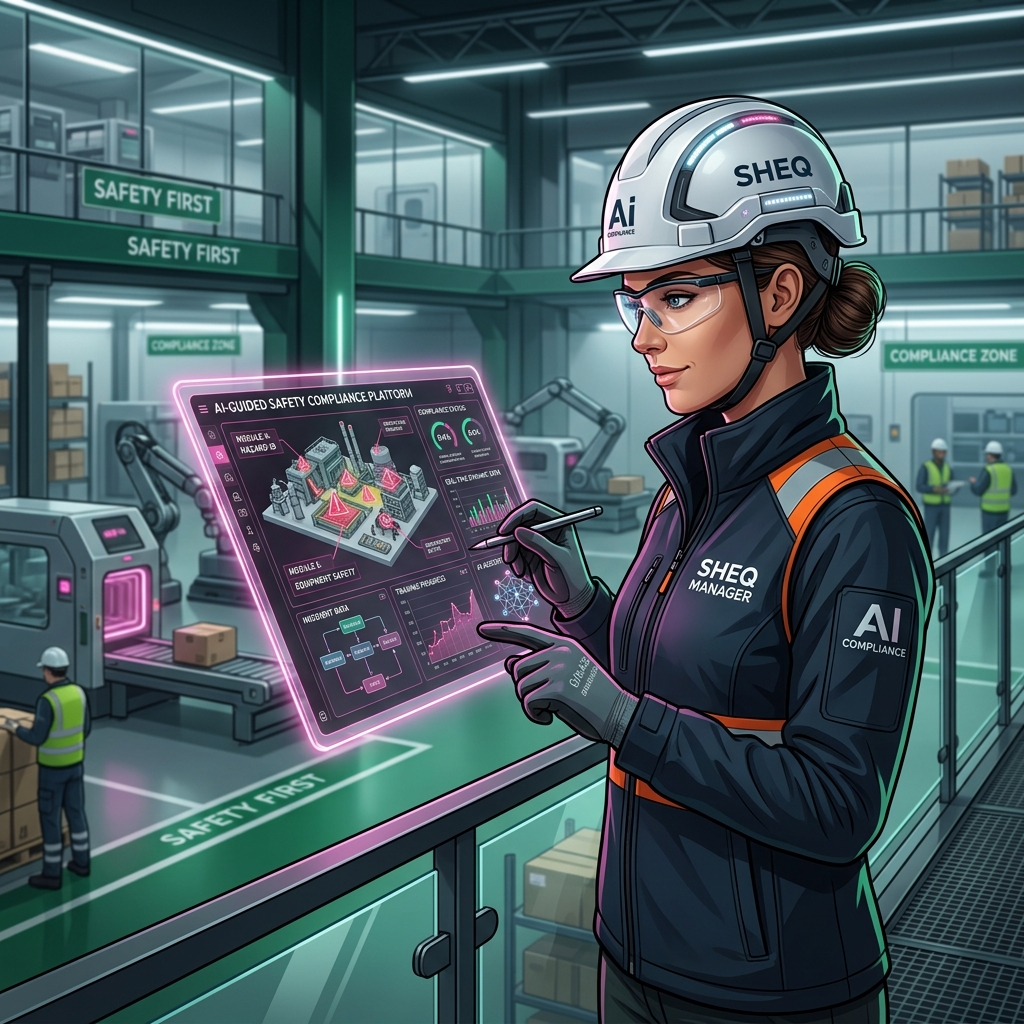
For over two decades, corporate safety compliance has been anchored by a single technical standard: SCORM (Sharable Content Object Reference Model). Developed in the late 1990s, SCORM allowed structured slides to communicate basic completion metrics back to a Learning Management System (LMS). It was a massive step forward for its time, enabling safety managers to verify that a worker clicked through a slide deck and passed a basic multiple-choice quiz.
However, in the high-stakes arena of occupational health and safety (OHS) and risk management, legacy SCORM packages have become a critical operational bottleneck. Rigid, linear, and completely static, traditional slide-based training cannot adapt to the dynamic operational realities of modern workforces. For Safety, Health, Environment, and Quality (SHEQ) managers, corporate supervisors, and business owners, relying on generic compliance modules is no longer just an engagement problem—it is a significant operational liability.
True compliance is not about ticking a box; it is about verifying real competency and understanding. This is where AI-guided e-learning steps in. By replacing static files with adaptive, real-time intelligence, AI-guided systems are revolutionizing workplace compliance training. These systems move beyond generic training to deliver personalized education that actively protects workers and shields businesses from legal risk.

The Core Failures of Legacy SCORM in High-Risk Workplaces
Traditional SCORM modules suffer from inherent limitations that make them ill-suited for modern, high-risk operational environments. Before transitioning to an intelligent framework, SHEQ managers must recognize these structural weaknesses:
- Static and Obsolete Content: SCORM packages are pre-compiled zip archives. When site safety specifications change, standard operating procedures are updated, or new machinery is introduced, the training modules cannot easily adapt. Updating them requires hiring instructional designers, rewriting storylines, re-exporting, and manually uploading files, completely stalling any efforts toward sheq training automation.
- Disengaged "Click-Through" Behavior: Workers quickly learn how to mute the tab, click "next" as fast as possible, and guess multiple-choice questions until they pass. This type of passive training does not translate into real-world behavior, leaving workers unprepared for hazards on the factory floor or construction site.
- A Complete Lack of Personalization: A veteran heavy-machinery operator with twenty years of experience is forced through the exact same three-hour basic induction as a newly hired administrative clerk. This wastes valuable production time and frustrates experienced workers, fostering a corporate culture that views safety compliance as a bureaucratic hurdle rather than a life-saving tool.
To overcome these limitations, leading organizations are transitioning to a dynamic, RAG-grounded training methodology. By anchoring AI models to verified, internal safety documentation, companies can ensure training is always accurate, current, and directly aligned with on-site risks.
How the RAG Training Framework Redefines Compliance Learning
Retrieval-Augmented Generation (RAG) acts as the bridge between standard artificial intelligence and a company's unique, internal data assets. Unlike public AI models that draw from the open web, a system built on a RAG training framework draws answers exclusively from your official standard operating procedures, baseline risk assessments, equipment specifications, and hazard logs.

By grounding the training engine in your active company files, the system can instantly generate dynamic training blueprints. Instead of serving pre-recorded, generic videos, the AI dynamically generates text, scenarios, and verification challenges tailored to the worker’s specific job card, geographic site, and experience level. If a worker is assigned to handle high-voltage switchgear on Site A, their training blueprint will automatically prioritize local site isolation procedures, emergency protocols, and specific arc-flash risk assessments.
Unlike public AI models that often suffer from hallucinated data and generic assumptions, a closed-loop e-learning engine ensures absolute precision. When safety procedures are retrieved, they are directly mapped from your approved repository, guaranteeing that no worker is trained on incorrect or obsolete protocols. This closed-loop process solves the fundamental trust problem that has previously prevented safety managers from utilizing generative artificial intelligence in high-risk training scenarios.
This dynamic setup is powered by conversational safety AI. Rather than passively reading text, workers engage in a conversational Q&A format. A technician can ask: "What is the exact isolation sequence for the hydraulic pump on line 3?" The AI instantly retrieves the correct technical manual, summarizes the steps in clear, plain language, and asks secondary questions to confirm the technician understands the hazards. This interactive verification ensures that employees are not just completing a class, but demonstrating operational competence.
Meeting Strict South African Regulatory and Auditing Standards
For South African employers, OHS training is not merely an internal policy—it is a legal obligation under the OHS Act. Training programs must align with the South African Qualifications Authority (SAQA unit standards) and qualify as SETA compliant training to claim skills development levies and satisfy Department of Employment and Labour inspections.
AI-guided e-learning meets these standards by automatically logging every learning interaction and competency check. When a worker completes their interactive session, the system compiles a complete portfolio of evidence pdf. This document serves as a legally robust proof of training, including verified timestamps, conversational logs, and assessment scores.
Safety File Manager
All generated portfolios of evidence and training completions are routed directly into a centralized safety file manager, keeping the company continuously audit-ready.
Competency Records
System updates employee competency records automatically. If an inspector requests proof of training for high-risk work, it can be retrieved in seconds.
Digital Safety Records
Maintains immutable digital safety records for the entire organization, eliminating physical files, lost paper sheets, and missing signatures.
Frontline Enablement: Mobile, Voice, and Hands-Free Safety Training
One of the greatest operational friction points in safety training is logistics. Pulling physical laborers, technicians, and operators away from their work areas to sit in a computer lab for a half-day safety course is expensive and logistically complex.
Next-generation platforms overcome this barrier through robust mobile safety training. Workers can access micro-learning modules directly on their tablets or mobile phones during morning safety briefings or while checking onto a new jobsite. This ensures safety concepts are top of mind when workers step onto the field.

Voice-Activated Learning and Session Portability
For workers operating in active, hands-on zones, systems support voice safety training and hands-free safety training. Using natural language speech recognition, a technician wearing a headset can converse with the AI safety assistant while keeping their eyes on the machinery. The AI reads out standard safety procedures, and the worker verbally verifies each safety parameter, keeping compliance active and hands free.
To ensure training matches the fluid movements of site workers, systems implement cross channel session portability. An employee can start a hazard-identification module on a desktop computer in the main administrative building, pause the session, and pick it up immediately on their mobile phone while walking to the work site. The system tracks progress in real-time, preventing lost hours or redundant training.
Enterprise Control: Automated Auditing and the OmniShield Portal
For corporate SHEQ directors, safety agents, and operational managers, keeping track of safety compliance across multiple construction projects, factories, and sub-contractor teams is a monumental task. Without continuous oversight, lapses in training and expired certificates can quickly turn into legal liabilities or site shut-down notices.
To solve this, safety systems must provide centralized control. The omnishield corporate portal serves as a master command dashboard, aggregating safety metrics, training completions, and compliance indicators across the entire enterprise. Within the portal, advanced compliance reporting software processes raw training data to deliver live reports, highlight compliance gaps, and score active safety postures.
This centralized oversight enables continuous, automated compliance auditing. Instead of manually reviewing paper safety records and training registers, the system automatically audits every employee profile. If a crane operator’s medical fitness certificate or crane competency record is within 30 days of expiring, the portal flags it, alerts the supervisor, and blocks the worker's digital access to high-risk task assignments until they complete the relevant AI-guided refresher training.
The Business Case: Lower Downtime and Better Safety Outcomes
Adopting AI-guided compliance training is not just a regulatory improvement; it is a highly beneficial operational decision. Traditional safety training results in significant lost-time hours. By transitioning to micro-learning models powered by conversational AI, companies can reduce overall training downtime by up to 50%, saving millions in lost production.
Additionally, the administrative overhead associated with managing traditional safety portfolios is virtually eliminated. SHEQ managers no longer need to spend hours printing, scanning, and filing physical documents. Because training is tracked and certified digitally in real-time, compliance reports can be compiled with a single click, allowing safety departments to focus their efforts on actual on-site hazards rather than paper administration.
More importantly, because training is interactive, personalized, and site-specific, information retention is significantly higher. Workers are better equipped to recognize hazards, report risks, and respond to emergencies, directly reducing incident rates and LTI frequencies. When safety training is aligned with the actual tools and procedures workers use daily, compliance becomes an active habit rather than a forgotten slide deck.
Stepping into the Future of Workplace Safety
Static slides, generic questionnaires, and rigid SCORM packages belong to the early days of digital compliance. Today’s fast-moving regulatory environments and complex project sites require a safety ecosystem that is dynamic, intelligent, and highly portable.
By combining a RAG training framework with conversational safety AI and robust mobile accessibility, companies can build an active safety culture that protects their workforce, satisfies inspectors, and streamlines compliance auditing.
At Omnisafe, we are building the digital tools to power this safety revolution. From our comprehensive safety file manager to continuous training auditing inside the omnishield corporate portal, we help South African businesses go paperless, stay compliant, and protect their most valuable assets.