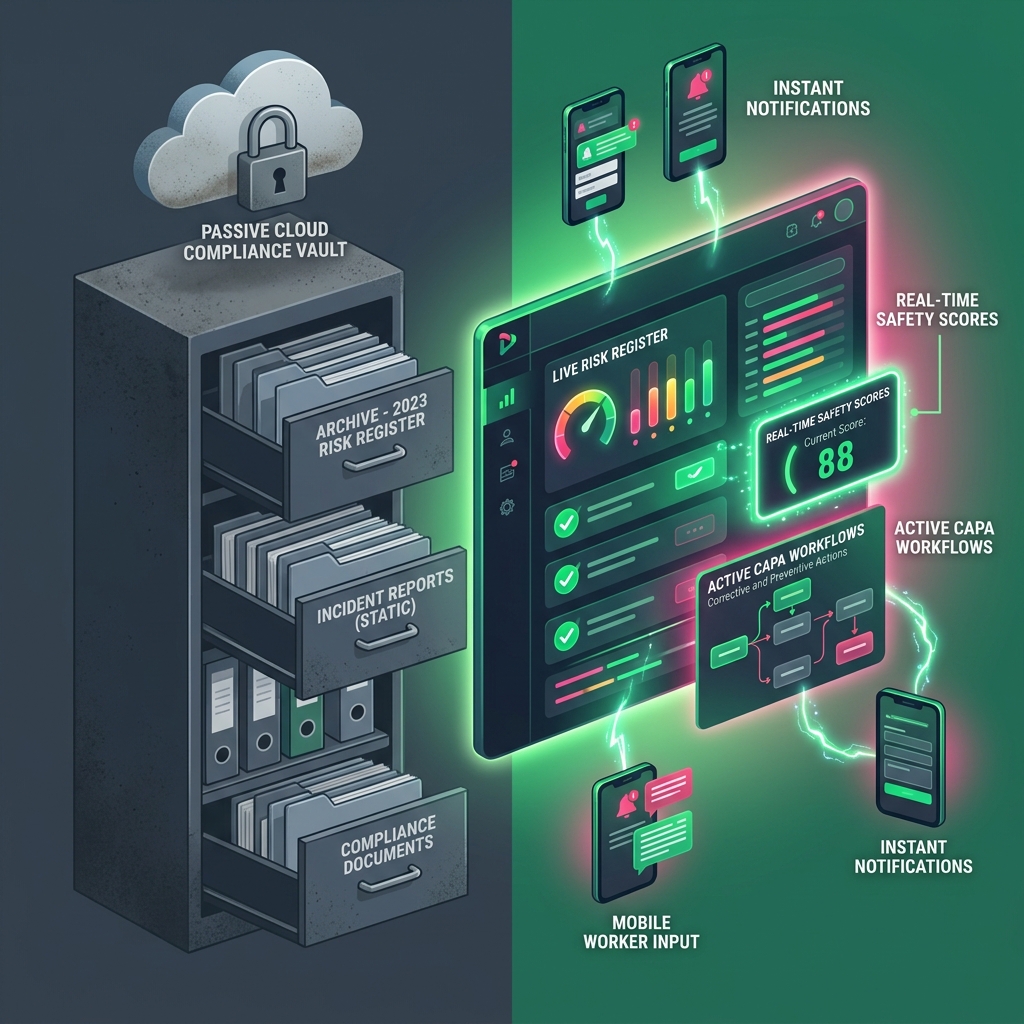
In the drive to modernize workplace operations, many companies believe they have successfully digitized their occupational health and safety (OHS) departments. They have scanning offices, compliance representatives, and a cloud drive. They have moved their lever-arch binders to Google Drive, Dropbox, or a shared corporate network.
In the safety industry, this is commonly referred to as adopting electronic safety files. While moving away from paper files reduces physical storage and printing costs, it is a common mistake to assume that document hosting is equivalent to risk management. A collection of static PDFs stored in a cloud compliance vault is just a digital version of a physical filing cabinet. It remains passive, historical, and disconnected from the daily operational risks on the ground.
To actively reduce incident rates and satisfy OHS audits, organizations must shift from static folders to a dynamic risk management system. A dynamic setup does not simply host documents; it processes data, automates tasks, and connects field activity directly to compliance records.
Reactive vs. Proactive Safety: The Operational Contrast
The fundamental difference between static document hosting and dynamic management lies in the operational approach. Understanding this contrast is key to improving safety outcomes:
The distinction between reactive vs proactive safety is critical for high-risk operations. A static folder is reactive. It records historical data, proving that an employee signed a form or completed training months ago. However, if an employee's medical fitness certificate expires, a machine misses its service date, or a worker fails to complete their morning safety briefing, a static folder cannot flag the gap. The omission is usually discovered only after an accident occurs or during a regulatory audit.
In high-risk industries like South African construction and mining, reactive management has severe commercial consequences. Under the OHS Act, if an inspector walks onto a site and discovers that workers are operating machinery with lapsed medical fitness certificates or expired training certifications, they can issue an immediate Section 30 Prohibition Notice. This stops all on-site work, resulting in massive contract delays, financial penalties, and damage to corporate reputation. Moving to a proactive model actively shields your business from these operational disruptions.
A dynamic risk management system, by contrast, enables proactive hazard mitigation. Instead of waiting for audits, the platform continuously monitors training records, equipment logs, and field checks. If a worker is scheduled for a high-risk task but their competency record has expired, the system alerts the supervisor, logs the gap, and blocks the worker's digital access to the task before they enter the work area.
Static HIRA Registers vs. The Live Risk Register
A core element of OHS compliance under the South African Occupational Health and Safety (OHS) Act is the Hazard Identification and Risk Assessment (HIRA). Typically, safety officers compile a static HIRA register in Excel, print it, file it in the safety binder, and review it only once a year.
This static register does not reflect the daily hazards of an active project site. On a construction site or factory floor, hazards change daily due to weather, machinery wear, and subcontractor shifts. A modern safety platform replaces static lists with a live risk register. By linking field reports and safety checks directly to the HIRA framework, the live register recalculates risk levels as new data is logged, keeping the risk assessment aligned with actual site conditions.
Safety File Manager Integration
Instead of loose cloud folders, an integrated safety file manager links baseline assessments directly to individual site folders and worker profiles.
Verifiable Digital Safety Records
Logs all approvals and daily checks as secure, cryptographically timestamped digital safety records, preventing document tempering.
Frontline Data Capture: Forms, Checklists, and WhatsApp Reporting
For a safety platform to be dynamic, it must capture data from the frontline. If supervisors and operators find reporting complex, they will revert to paper logs, leaving management with outdated compliance records.
Modern platforms simplify this through mobile digital forms and checklists. Rather than filling out paper sheets, workers complete pre-task checks and vehicle logs on their mobile devices. For remote sites or areas with poor cellular coverage, the system supports offline site inspections. Workers log checks locally on their devices, and the system syncs the data to the cloud once a network connection is detected.
This offline capability is crucial for engineering teams and contractors working in remote geological areas, deep mining shafts, or steel-structured warehouses where cellular signals cannot penetrate. By allowing inspectors to log checklists, upload photos of structural hazards, and sign off digitally while disconnected, the system ensures safety checks continue uninterrupted. The moment the device reconnects to a network, the local draft is automatically uploaded, updating the centralized system without any manual intervention.
Additionally, integrating everyday messaging tools like whatsapp safety reporting allows frontline workers to report hazards instantly. A worker can snap a photo of a hazard, send it to the dedicated safety number via WhatsApp, and the system automatically logs the hazard, alerts the safety rep, and updates the risk register in real-time.
Closing the Loop: Automated CAPA and OmniAudit AI
Logging a hazard is only the first step. To comply with national safety standards and guidelines, such as the Compensation for Occupational Injuries and Diseases (COID) Act, organizations must demonstrate that hazards are resolved.
A dynamic system manages this by automatically generating a list of tracked CAPA action items when a hazard is reported. The system assigns tasks, tracks remediation, and sends alerts to ensure the hazard is resolved, closing the compliance loop.
This continuous monitoring enables automated auditing. Instead of manual monthly file reviews, the system utilizes OmniAudit AI to perform continuous, automated compliance auditing across all site files. The AI scans training records, equipment logs, and CAPA tasks daily, flagging gaps so they can be resolved before inspectors arrive on-site.
For example, the AI engine monitors subcontractor databases, automatically checking that each team has uploaded their COIDA Letter of Good Standing, signed their mandatory Section 37.2 agreements, and registered their active workers. If any document is missing or expired, the system alerts the safety supervisor via email or dashboard notification, outlining the exact corrective action required. This removes the administrative burden of audit preparation, turning safety departments from record-keeping clerks into active risk auditors.
The Business Case for Dynamic SHEQ Software
Relying on a static cloud vault leaves your business exposed to compliance gaps and administrative delays. By transitioning to a dynamic, unified SHEQ software platform, you can eliminate manual file tracking, reduce on-site incident rates, and keep your teams audit-ready.
If your business is currently using physical binders or static cloud folders, migrating to a dynamic system is a straightforward operational change. You can review our step-by-step migration guide on Transitioning Your Business to Digital Safety Files to learn how to prepare your safety data and train your teams. Additionally, for enterprises managing multiple compliance standards, our guide on Automating ISO 9001, ISO 45001, and ISO 27001 Compliance shows how a dynamic platform maps operational data to international standards.
Build a Safer, Simpler Safety Culture
Compliance is not about accumulating digital paperwork in a folder. It is about actively monitoring risk, validating worker competency, and resolving hazards on the ground.
With Omnisafe, you can move beyond static files and deploy an active, AI-guided compliance platform that protects your workforce and keeps you audit-ready. From live risk registers to automated CAPA tracking, Omnisafe gives you everything you need to manage safety at a single glance.
Stop managing safety with flat cloud storage. Book a custom demo today or explore our pricing plans to discover how Omnisafe can modernize your compliance.