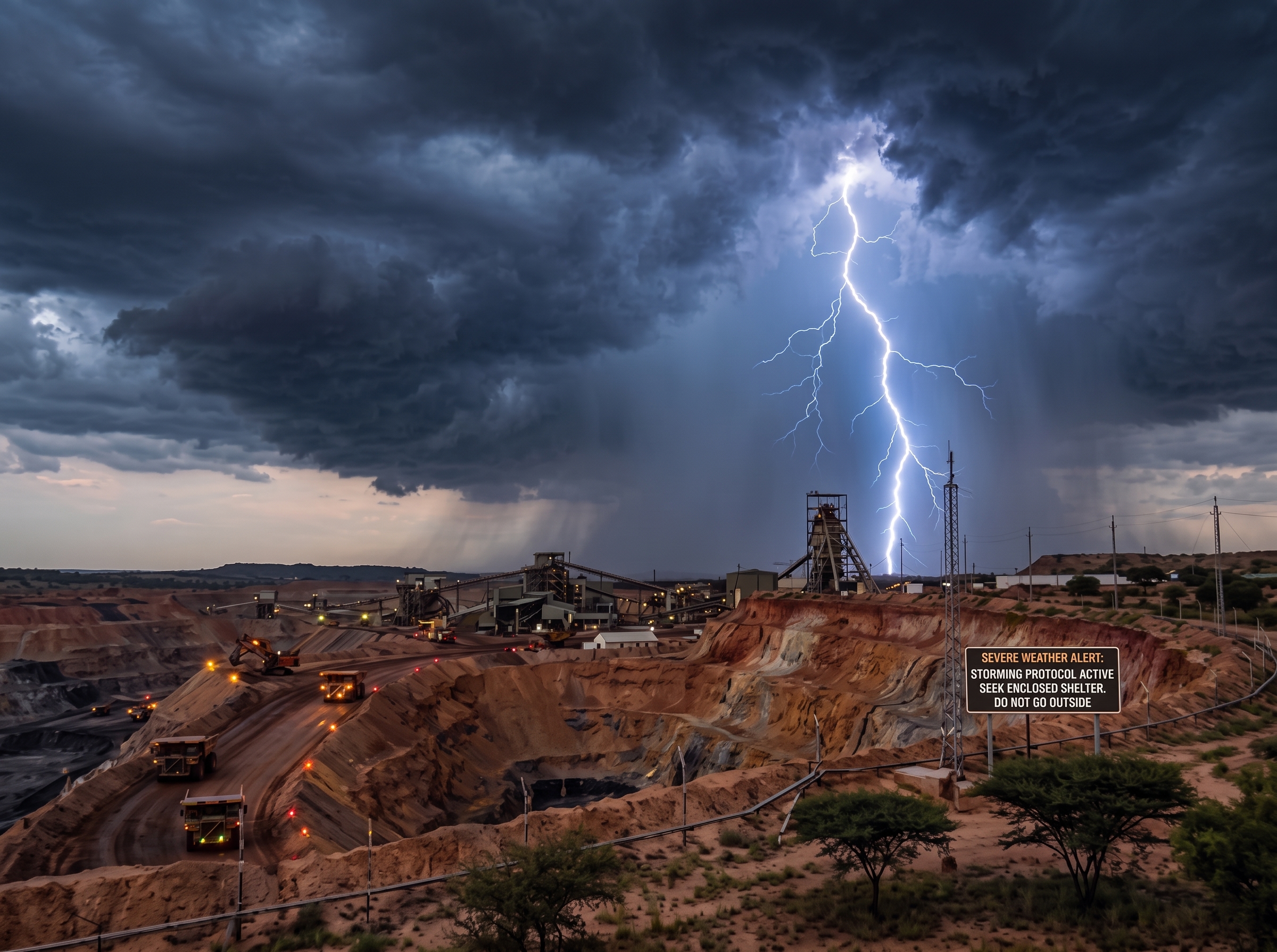
South Africa experiences some of the highest ground flash densities in the world, exceeding 15 lightning strikes per square kilometre annually across the Highveld, Mpumalanga, KwaZulu-Natal, and the Eastern Cape.
In high-risk sectors—such as construction, opencast mining, civil engineering, and commercial agriculture—sudden lightning strikes, gale-force winds, torrential downpours, and severe heatwaves present immediate life-safety hazards.
Under Section 8 of the Occupational Health and Safety (OHS) Act 85 of 1993, employers carry a strict, non-delegable duty of care to maintain a work environment that is safe and free of risk.
To eliminate manual weather guesswork and prevent catastrophic on-site accidents, OmniSafe has officially launched WeatherGuard—an automated, site-based severe weather and lightning early-warning shield integrated directly into your OmniSafe workspace and WhatsApp Hub.
What Are the Risks of Traditional Severe Weather Monitoring and Phone GPS Tracking?
When severe weather approaches an industrial site, safety officers typically face two dangerous extremes:
- ✗ Visual & Auditory Observation: Relying on sight or sound (like hearing thunder when a storm is already in lethal range).
- ✗ Uncoordinated Shutdowns: Enforcing manual site closures that lead to costly, unnecessary downtime.
Attempts by generic software vendors to solve this through continuous smartphone GPS tracking fail in the field:
Severe Battery & Data Drain
High-frequency GPS polling drains standard field phones within 3 to 5 hours and burns through workers' personal prepaid mobile data bundles.
Operating System Throttling
Mobile browsers and Progressive Web Apps (PWAs) terminate background GPS execution within 30 to 60 seconds after a worker locks their screen, causing silent alert failures.
POPIA & Union Pushback
Tracking employee locations around the clock triggers severe privacy liabilities under the Protection of Personal Information Act (POPIA) and union friction.
How Does WeatherGuard Resolve Severe Weather Safety via Static Site Geofencing on WhatsApp?
WeatherGuard decouples worker safety from continuous personal tracking. Safety administrators establish fixed GPS coordinates and a safety perimeter (such as a 15 km alert zone) around their facility, depot, farm estate, or municipal area. OmniSafe evaluates atmospheric telemetry in the cloud against the site location itself.
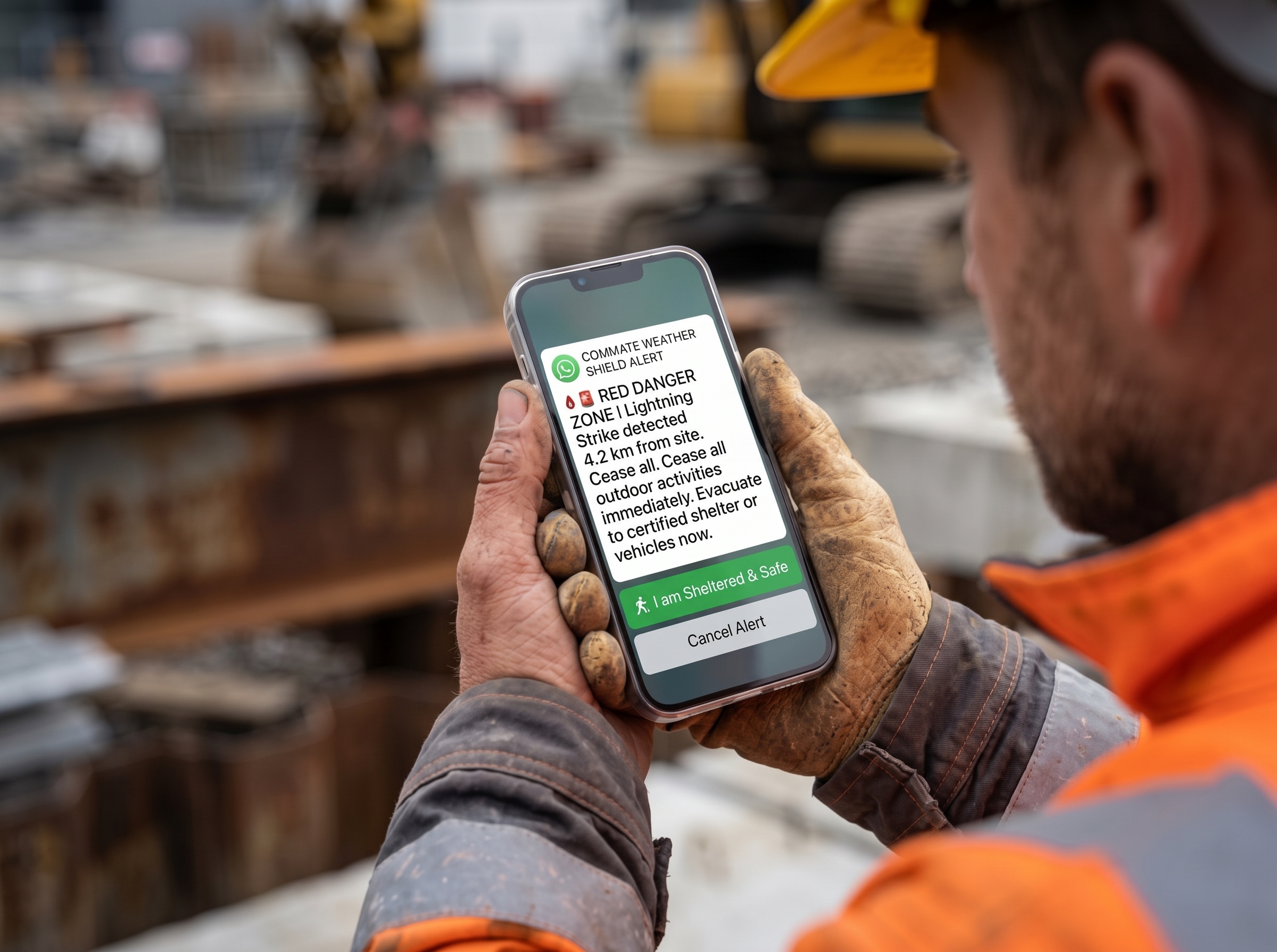
When a hazard breaches the perimeter, emergency directives dispatch instantly to rostered personnel via WhatsApp—the zero-data-barrier platform workers use every day.
| Evaluation Criterion | WeatherGuard (Static Site Geofencing via WhatsApp) | Traditional Mobile Phone GPS Tracking |
|---|---|---|
| Field Device Reliability | 100% Reliable: Cloud evaluated; zero client-side background execution or battery drain. | Unreliable: Background GPS throttled or terminated by mobile operating systems. |
| Worker Data Consumption | Negligible: Operates via WhatsApp text and interactive buttons. | Heavy: Constant GPS polling rapidly burns worker airtime and prepaid bundles. |
| POPIA & Labor Legality | Fully Compliant: Monitors employer-controlled site coordinates, not personal devices. | High Legal Risk: Continuous employee geolocation triggers Section 11/14 POPIA liabilities. |
| Alert Delivery Speed | Sub-Second Push: Priority Meta Cloud WhatsApp dispatch straight to handsets. | Fragile: In-app notifications drop when apps are closed or killed by battery savers. |
How Does WeatherGuard Manage the 4-Stage Storm Safety Lifecycle?
High-risk operations cannot afford incomplete alerting. Dispatching an evacuation warning without an automated All-Clear creates chaos or prolonged downtime.
WeatherGuard automates the complete storm lifecycle in alignment with SANS 10313:2012 and the 30-30 safety rule:
Advisory Watch (25 km to 30 km)
When convective electrification or approaching strikes are detected within 30 km, WeatherGuard sends an early heads-up to Site Supervisors and Safety Officers. Cranes prepare to lower ungrounded loads, and outdoor crews prepare designated shelters.
Emergency Warning & Evacuation (<15 km)
The moment a verified cloud-to-ground strike occurs within the site's critical perimeter, WeatherGuard triggers an automated WhatsApp broadcast to every active employee assigned to the site. Outdoor operations halt immediately, crane booms are lowered, and personnel evacuate to enclosed structures or vehicles.
Active Cooldown Monitoring
During an active storm, dozens of strikes may hit the area. WeatherGuard’s built-in debounce engine suppresses duplicate panic messages. Every time a new strike is recorded inside the radius, an automated 30-minute safety timer resets silently.
Automated SANS 10313 All-Clear
Once a full 30 consecutive minutes of zero lightning strikes have elapsed within the safety zone, WeatherGuard automatically broadcasts an "All-Clear" notification via WhatsApp: "Storm passed. Safe to resume operations."
What Environmental Hazards Does WeatherGuard Monitor Under South African OHS Regulations?
Industrial risk extends beyond lightning. WeatherGuard uses a unified meteorological engine to monitor four major statutory environmental tripwires simultaneously:

1. Gale-Force Wind & Crane Lift Safety
- Regulatory Standard: OHS Act Driven Machinery Regulations (DMR 18) and SANS 10160-1.
- The Risk: Tower cranes and mobile telescopic cranes must cease lifting operations when sustained wind speeds exceed 38 km/h (10.8 m/s), and scaffolding becomes hazardous in gusts exceeding 50 km/h.
- Automated Action: WeatherGuard detects anemometer threshold breaches, alerting rigging supervisors to ground suspended loads and release crane slew brakes for mandatory weathervaning.
2. Flash Floods & Deep Trench Collapse
- Regulatory Standard: SANS 10400-R and OHS Construction Regulations (Excavations).
- The Risk: Torrential downpours (≥ 25 mm/hr) liquefy excavation sidewalls, risking fatal cave-ins in trenches deeper than 1.5 metres, while turning opencast haulage roads into slick skid hazards.
- Automated Action: Evacuation directives are dispatched immediately to civil and excavation crews, ordering earthmoving equipment to park and trench personnel to seek higher ground.
3. Thermal Heat Stress Index (WBGT)
- Regulatory Standard: OHS Act Environmental Regulations for Workplaces (Section 2 - Thermal Requirements) and ISO 7243.
- The Risk: Ambient thermometers ignore relative humidity, solar radiation, and wind cooling. In commercial agriculture, steel fabrication, and open pits, thermal strain causes heat exhaustion and heatstroke.
- Automated Action: WeatherGuard calculates the outdoor Wet Bulb Globe Temperature (WBGT) in real time. When WBGT exceeds 31°C to 32.2°C, the system issues mandatory work/rest directives (e.g., 45 minutes of work followed by 15 minutes of shaded rest and electrolyte hydration).
How Does Real-Time Interactive Evacuation Headcount Work via WhatsApp?
During an emergency evacuation, knowing that an alert was sent is only half the battle; safety managers must verify who is actually safe.
⚠️ OMNISAFE SEVERE WEATHER EMERGENCY: Secunda Plant
⚡ HAZARD: Lightning strike detected 5.4km from site.
🛑 DIRECTIVE: SANS 10313 Protocol Active. Evacuate outdoor areas immediately.
Please confirm your status:
Live Headcount Progress Bar
On the OmniSafe dashboard, Safety Officers see an instant visual tally (e.g., 🟢 38 / 42 Personnel Confirmed in Shelter (90%)) updated in real time as workers tap their confirmation buttons.
1-Click Emergency Escalation
Unacknowledged workers are highlighted in red, equipping the safety team with instant "📞 Call Worker" and "💬 WhatsApp Direct" buttons for targeted check-ins.
Why Is WeatherGuard's Incident Black Box Critical for Department of Labour Inquests?
When severe weather incidents occur, employers face rigorous formal inquiries from the Department of Employment and Labour (DEL) or the Mine Health and Safety Inspectorate. If an employee is injured, verbal assertions that "we evacuated the site" do not hold up in court.
WeatherGuard incorporates an immutable Tier 3 Incident Black Box:
📡 Full Chronological Telemetry
Captures raw satellite/sensor lightning coordinates, peak current in kiloamperes (kA), distance from site centroid, and exact strike timestamps.
📲 Handset Delivery Proof
Records the exact millisecond each WhatsApp emergency message was sent, delivered to the handset, read by the worker, and acknowledged with a safety confirmation.
🔐 Cryptographic Tamper-Proofing
Every completed incident file is stamped with a SHA-256 cryptographic hash, creating an immutable Portfolio of Evidence ready for legal inquiries and insurance claims.
📑 1-Click OHS Evacuation Certificate
Safety officers can export an official, company-branded A4 PDF summary detailing the incident chronology and evacuation sign-off register with one click.
What Site Archetypes and Pricing Options Are Available for WeatherGuard?
Whether your business operates from a compact manufacturing plant or covers mobile service routes across an entire municipality, WeatherGuard adapts to your geographic footprint:
Fixed Facilities & Plants
Tailored 12–15 km perimeters for factories, warehouses, refineries, and logistics depots.
Farms & Agricultural Estates
15–20 km perimeters covering extensive orchards, vineyards, crop fields, and opencast pits.
Town & Municipal Jurisdictions
25–35 km wide-area centroids designed for electrical contractors, civils teams, and road maintenance crews.
Custom Geofence Perimeters
User-adjustable boundaries (5 km to 50 km) for linear pipeline corridors and multi-site projects.
Simple, Predictable Site Pricing
Catalog an unlimited number of registered sites in your OmniSafe workspace at R0.00 extra cost for forms, checklists, and safety file indexing.
When you activate 24/7 automated meteorological monitoring on a site, assign a Weather_Watch_License. Toggle on or off as active projects change.
How Do You Activate WeatherGuard on Your Sites Today?
WeatherGuard is now live for all OmniSafe subscribers. Protect your workforce and automate your OHS Act Section 8 compliance in three simple steps:
Sites & Geofences
Navigate to Tenant Settings → Sites & Geofences in your administrative menu.
Toggle Weather Shield
Drop a pin on your coordinates, select your alert perimeters, and toggle Weather Shield Active.